
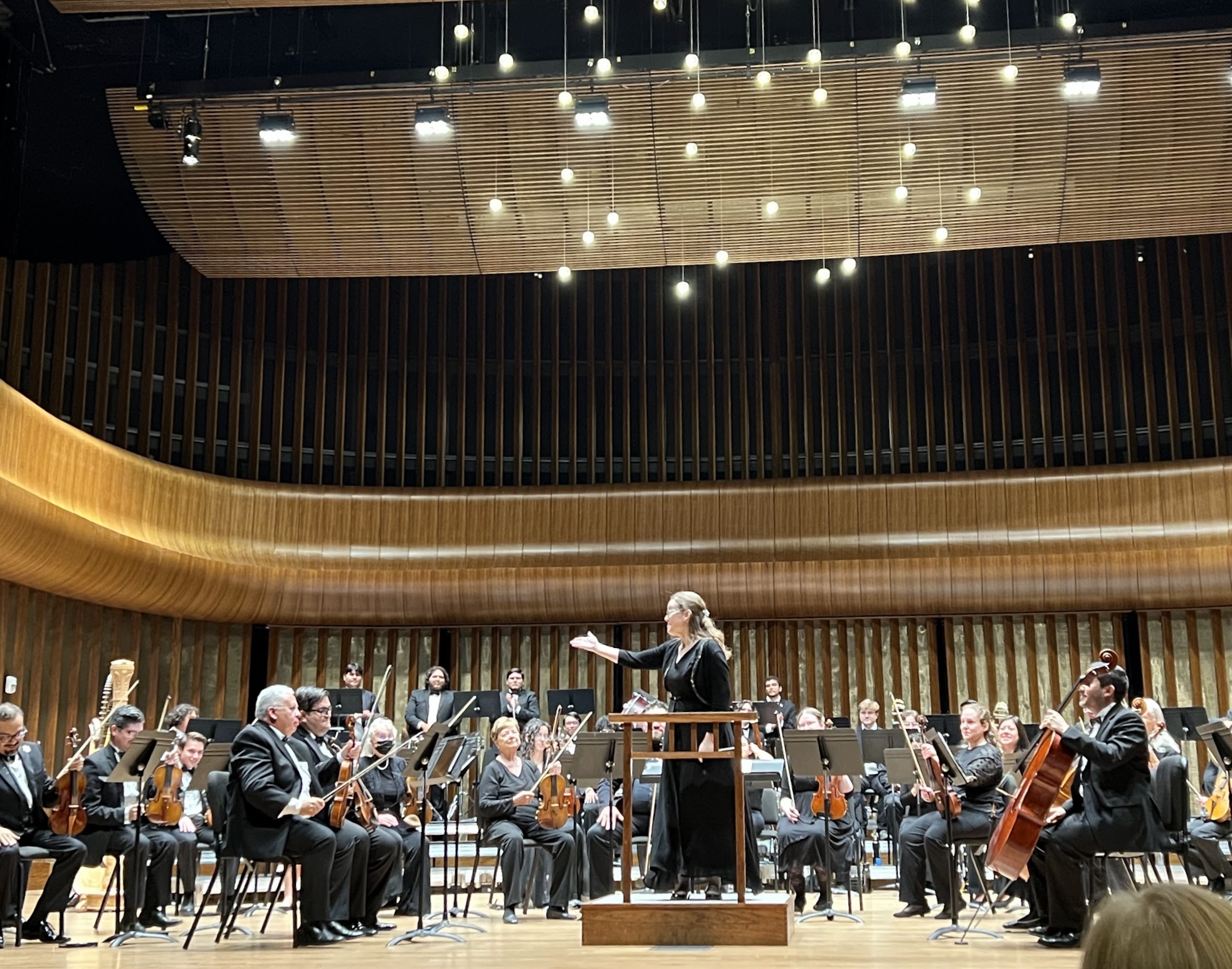
Dr. Colleen Ferguson conducts the Kingsville Symphony Orchestra during a performance at the Texas A&M University–Kingsville Performance Hall. The orchestra blends student musicians with working professionals from across South Texas | Courtesy Photo
By Claudia Perez Rivas | Kingsville Independent News
The room settles slowly. Chairs shift. Instruments tune. Conversations fade into a low hum before disappearing altogether. For a moment, everyone, musicians and audience alike, is waiting for the same thing.
That moment is where the symphony really begins.
Long before that silence takes hold, people arrive at the Texas A&M University–Kingsville Performance Hall from different directions, longtime residents, students, families, newcomers who heard there was “a symphony here.” Inside, musicians greet one another, unpack instruments and warm up. Some have rehearsed together for years. Others are reuniting after traveling in from across South Texas.
By the time the house lights dim, what’s on stage isn’t just an orchestra. It’s a cross-section of the community.
Dr. Colleen Ferguson, artistic director and conductor of the Kingsville Symphony Orchestra, describes that shared effort as central to what the orchestra is and how it operates.
How the orchestra works and who’s on stage
The Kingsville Symphony Orchestra brings together about 30 to 35 student musicians from Texas A&M University–Kingsville with 20 to 30 professional musicians who travel to Kingsville for concert weekends. Participation in the orchestra is by audition for everyone, a process Ferguson said helps ensure the orchestra maintains a professional standard while giving students meaningful, earned experience.
That sense of continuity extends to guest soloists, Ferguson said, noting that the orchestra’s upcoming concert will feature violinist Williams Naranjo, a former member who is returning to Kingsville as guest artist after relocating to Florida.

Students form the core of the ensemble. The professional musicians, many of whom perform regularly with symphonies across Texas, rehearse and perform alongside them.
“There’s no separation on stage,” Ferguson said. “They’re integrated.”
That structure is intentional. It allows students to gain professional-level experience early in their training, while positioning the orchestra itself as more than a classroom ensemble.
“I do not consider us a student orchestra,” Ferguson said. “I consider us a regional professional orchestra, and we perform the same level of literature as any of the regional orchestras in our area.”
What happens in the room
What audiences experience, however, isn’t a lesson in how the orchestra is built. They experience something live, something that exists only for the people in the room.
In an era when music is instantly available through recordings and streaming, Ferguson believes the value of live orchestral music can be easy to overlook.
“When we listen to a recording, it’s going to be exactly the same every time,” she said. “But a live performance will always be different.”
Each concert unfolds differently, shaped by how musicians respond to one another, how sound moves through the hall and how the audience listens. From the podium, Ferguson said that presence is tangible.
“As a conductor, I can feel the energy of the audience,” she said. “Having that audience there in the moment changes things for us on stage.”
For listeners, the experience isn’t passive. There’s no pause button, no rewind. The music happens once, in real time, and how it lands, whether it surprises, unsettles or moves someone, can’t be predicted. Then it’s gone.
An orchestra without barriers
Ferguson is aware that some people hesitate to attend their first symphony concert because they assume they don’t belong that they don’t know enough, won’t understand the music or won’t fit in.
She’s direct about pushing back against that idea.
“There’s no dress code,” she said. “There’s no requirement to know anything ahead of time. Just bring an open mind and curiosity.”
She compares attending a symphony to walking into an art museum for the first time. You don’t need context or vocabulary to start. You notice what the experience brings up, calm, tension, joy, reflection, and that becomes your entry point.
The music itself, she said, was written by people working through the same human experiences listeners bring with them into the hall.
“They were human beings,” Ferguson said. “They had struggles, joys, disappointments just like we do.”
A cultural anchor shaped by partnership
This season marks the 20th anniversary of the Kingsville Symphony Orchestra, a milestone that coincides with a growing emphasis on community collaboration.
In December, the orchestra partnered with Elevé Dance Studio and The Douglass Youth Center to present a Nutcracker production involving local dancers, youth performers and live orchestral music. The project included a student matinee and a sold-out public performance.
Ferguson said partnerships like these reflect the orchestra’s broader role in Kingsville, one built not only around concerts, but around shared experiences that extend beyond the stage.
The orchestra’s work is supported by the broader infrastructure of Texas A&M University–Kingsville’s School of Music, one of the largest and oldest music programs in South Texas, with facilities designed to support large ensembles performing at a professional level.
A place to gather
Ferguson said she often hears the same thing from first-time attendees, especially those new to Kingsville: they didn’t realize something like this existed here.
Not because they weren’t interested, but because they didn’t know what to expect.
Her hope is that the symphony becomes less of a discovery and more of a familiar gathering, a place people return to because of how it feels to sit in the room while something unfolds live, once, and only once.
Nearly everything we experience now can be replayed or paused, but a symphony concert offers something simpler and rarer: shared attention.
For a little while, everyone listens, fully present in the moment.
Upcoming concert
Sunday, Feb. 22, 2026 | 3 p.m.
TAMUK Performance Hall
The Kingsville Symphony Orchestra will perform works by Mozart, Sibelius and Tchaikovsky, featuring violinist Williams Naranjo as guest artist.

Tickets are available online or at the door. Discounts available for veterans and students (ID required). Seating is open.
More information: kingsvillesymphony.org