
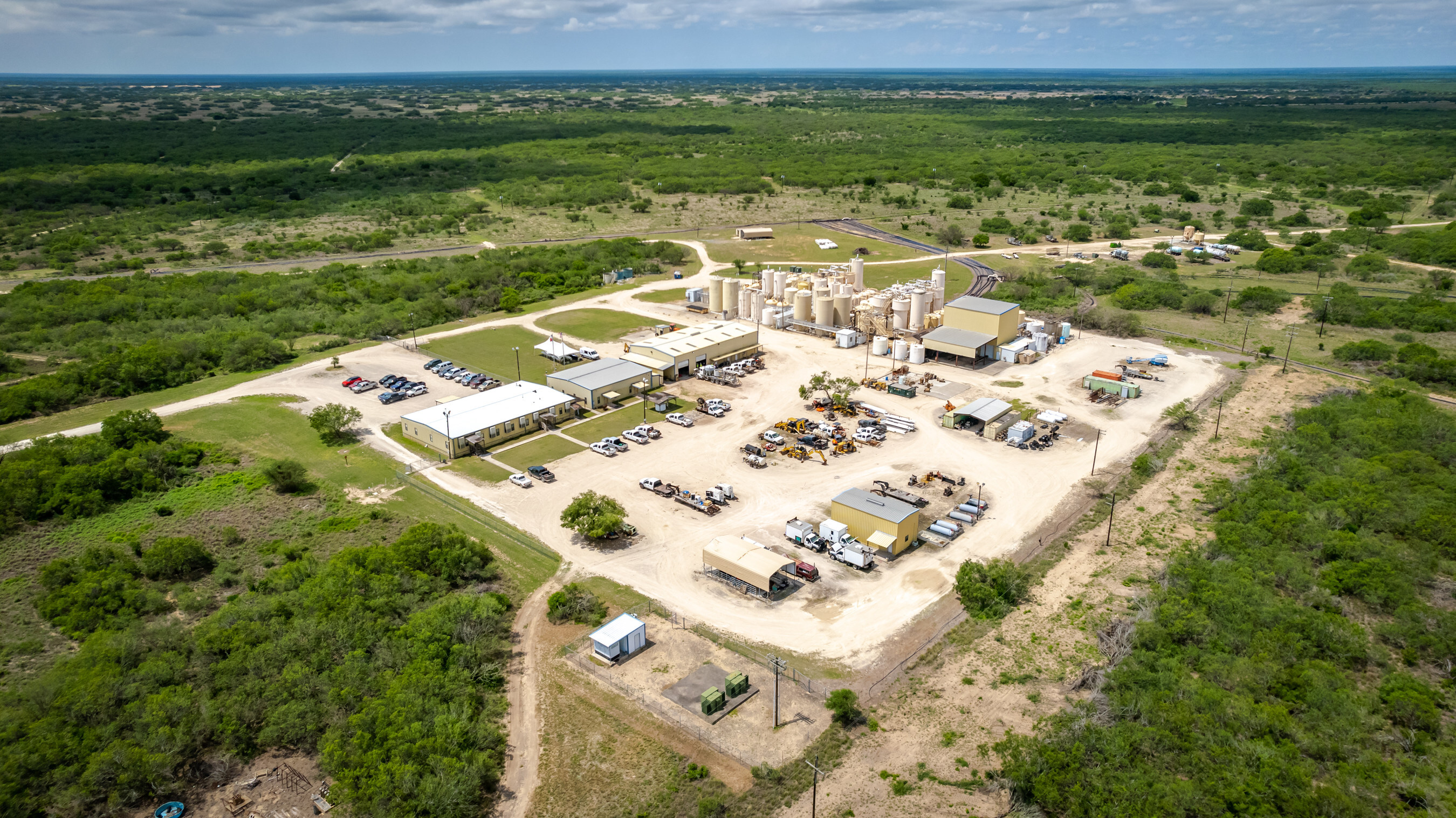
Photo caption: enCore Energy’s Alta Mesa Plant (CNW Group/enCore Energy Corp.)
By Kingsville Independent News Staff
As the United States seeks to expand nuclear power and reduce reliance on foreign uranium supplies, uranium mining, long part of South Texas’ history, is again drawing attention across the Coastal Bend and surrounding counties, including Brooks, Kleberg, Karnes and Goliad.
Industry analysts say rising uranium prices, supply chain concerns and renewed political support for nuclear energy have contributed to a broader revival of domestic uranium production. National reporting has described the shift as part of a push to secure fuel for existing nuclear reactors as utilities and policymakers reassess energy reliability and long-term planning.
In South Texas, that revival is no longer theoretical. In-situ recovery uranium production is already underway again in Brooks County, and operators are positioning the region’s existing facilities and mineral belts for expanded activity.
A long mining history beneath South Texas
According to the Texas State Historical Association, uranium mining in South Texas began in the 1950s, with Karnes and Goliad counties becoming among the nation’s most productive uranium areas by the 1970s. Activity declined in later decades as prices fell and imported uranium became cheaper.
Many facilities were placed on standby rather than dismantled, a factor that has allowed companies to restart production more quickly as market conditions changed.
Geologists note that uranium deposits in Brooks, Kleberg, Karnes and Goliad counties occur in sandstone formations suited to in-situ recovery, or ISR, a mining method that extracts uranium through underground wells rather than open pits.
How ISR mining works, and why it raises questions
ISR mining uses wells to circulate a solution through underground formations to dissolve uranium-bearing minerals, which are then pumped to the surface for processing. Unlike open-pit mining, ISR leaves the land surface largely undisturbed.
Federal regulators describe ISR as a method that requires detailed groundwater monitoring and restoration after mining concludes. In Texas, uranium mining is regulated by the Texas Commission on Environmental Quality in coordination with the U.S. Nuclear Regulatory Commission.
Critics argue that because ISR interacts directly with groundwater systems, it can pose risks if monitoring, containment or restoration fails, particularly in drought-prone regions where aquifers already face competing demands.
enCore Energy’s operations in Brooks and Kleberg counties
One of the most active uranium operators in South Texas is enCore Energy.
In Brooks County, enCore announced in June 2024 that it had restarted uranium production at its Alta Mesa in-situ recovery facility, which includes a central processing plant and associated wellfields. The company described the restart as phased production from a designated authorization area, with plans to expand operations over time.
Company filings and public statements identify Alta Mesa as one of the few currently producing uranium operations in the United States.
In Kleberg County, enCore lists the Kingsville Dome facility as part of its South Texas uranium portfolio. The company describes Kingsville Dome as a licensed ISR processing plant and wellfield that remains positioned for production as market conditions allow.
Company representatives have said existing permits, infrastructure and prior operations give South Texas projects an advantage compared with undeveloped uranium regions elsewhere.
Karnes County: A regional processing hub
Karnes County has long played a central role in South Texas uranium mining because it hosts the Hobson Central Processing Plant, operated by Uranium Energy Corp.
The company describes Hobson as a “hub” facility designed to process uranium-bearing materials from multiple project areas across South Texas using a hub-and-spoke model. Company materials identify Karnes County as a strategic processing center rather than solely a mining location.
Local impacts in Karnes County tend to focus on processing capacity, transportation activity and the role the county plays in supporting uranium projects beyond its borders.
Goliad County: A named project area, not an active mine
In Goliad County, uranium activity remains at the project and planning stage rather than active production.
Uranium Energy Corp. identifies a Goliad Project as part of its South Texas portfolio, describing it as an area with known uranium resources tied to the Hobson processing hub. Company materials indicate the project would require additional permitting, development and regulatory approvals before production could occur.
For Goliad County residents, the distinction between active mining and proposed development has become a key point of discussion, particularly among landowners concerned about groundwater and long-term land use.
County-by-county concerns and local stakes
Across all four counties, groundwater remains a central concern.
In Brooks County, where production is already underway, residents and water users are watching how groundwater monitoring and restoration commitments are implemented over time.
In Kleberg County, the presence of licensed uranium infrastructure has drawn attention in a region already facing drought pressures and growing competition for groundwater.
In Karnes County, the focus has been on the cumulative effects of processing activity and the county’s role in supporting uranium development elsewhere in South Texas.
In Goliad County, where ranching and private water wells are common, landowners have historically scrutinized proposed uranium projects for potential impacts on water quality and long-term property value.
State regulators have said uranium mining permits include groundwater protection standards and post-operation restoration requirements designed to return aquifers to baseline conditions.
A familiar debate returns
Supporters of renewed uranium mining argue it brings jobs, tax revenue and domestic energy security. Critics counter that uranium booms have come and gone before, often leaving unresolved environmental concerns.
What is clear is that South Texas, and specifically Brooks, Kleberg, Karnes and Goliad counties, has returned to the center of a national energy conversation.
With production underway in Brooks County and other projects positioned across the region, residents are likely to see increased regulatory activity, public meetings and debate over how uranium fits into South Texas’ future, and at what cost.
This story is part of Kingsville Independent News ongoing coverage of state-level policies with local impact in South Texas.