
A recent editorial and a federal court ruling have drawn attention to a little-known state law, raising questions about food labeling, consumer choice and who regulates what Texans eat
By Kingsville Independent News Staff
Most Texans have never seen lab-grown meat for sale, and many have never heard of it. But a recent federal court decision, followed by a strongly worded editorial from Texas Agriculture Commissioner Sid Miller, has drawn new attention to a state law that bans its sale, prompting questions about how food laws apply when new technologies emerge.
The court’s decision did not strike down Texas’ law or legalize lab-grown meat in the state. Instead, a federal judge declined to dismiss a lawsuit challenging the ban, allowing the case to move forward while the law remains in effect.
What is lab-grown meat?
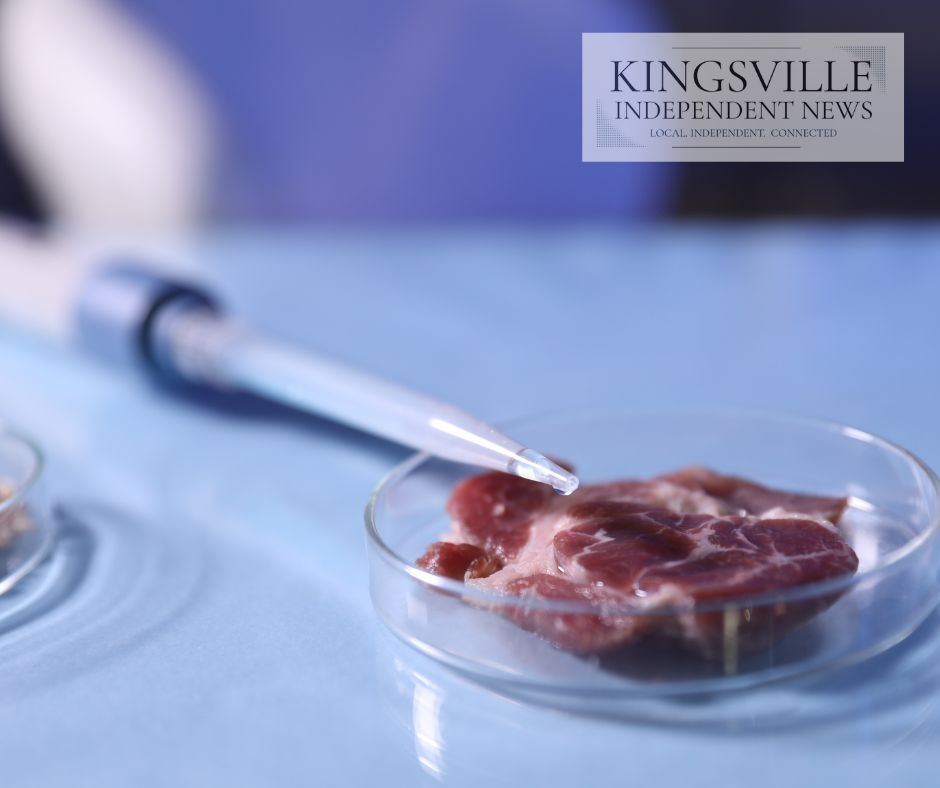
Lab-grown meat, also referred to as cultivated or cell-cultured meat, is produced by growing animal cells in a controlled environment rather than raising and slaughtering livestock. Unlike plant-based meat alternatives, it is derived from animal tissue.
At the federal level, oversight of lab-grown meat is shared by the U.S. Food and Drug Administration and the U.S. Department of Agriculture, according to guidance issued by the two agencies. A limited number of lab-grown meat products have received federal clearance for small-scale commercial use, though widespread consumer availability remains limited.
What does Texas’ law do?
Texas lawmakers approved the ban on lab-grown meat during the 2025 legislative session, and Gov. Greg Abbott signed the measure into law in June 2025. The law prohibits the sale of lab-grown meat in the state.
Supporters of the law, including state agricultural officials, have said the measure is intended to prevent consumer confusion, protect traditional livestock producers and ensure transparency in food labeling. That includes ranchers and cattle operations across Texas, where livestock agriculture remains a significant part of local economies.
The law does not apply to plant-based meat alternatives. It specifically addresses meat products grown from animal cells outside a conventional agricultural setting.
What is the lawsuit challenging?
Several companies developing lab-grown meat, including Wildtype and UPSIDE Foods, filed a federal lawsuit challenging Texas’ ban in September 2025, shortly after the law took effect. The case was filed in the U.S. District Court for the Western District of Texas.
In court filings, the companies argue that the state law conflicts with federal authority over food safety regulation and interstate commerce.
A federal judge in January 2026 declined to dismiss the case, a procedural decision that allows the lawsuit to proceed. The ruling did not address whether Texas’ law is constitutional or whether it will ultimately be upheld.
Why state officials are speaking out now
Following the judge’s decision, Texas Agriculture Commissioner Sid Miller published an editorial criticizing the lawsuit and the companies involved. In the editorial, Miller characterized the legal challenge as a threat to ranchers, rural livelihoods and the state’s authority to regulate its own food system.
Miller argued that lab-grown meat could concentrate control of food production in the hands of large corporations and undermine consumer trust in how food is produced and labeled. Those statements reflect Miller’s views and are not findings made by the court.
What supporters of lab-grown meat say
Companies developing lab-grown meat, including those involved in the lawsuit, say their products are intended to complement, not replace, traditional agriculture. In court filings and public statements, the companies say the technology could reduce environmental impacts, improve food security and expand consumer choice, while remaining subject to existing federal safety oversight.
Industry advocates and food-technology supporters have also argued that states do not have the authority to prohibit the sale of food products regulated at the federal level, a legal question central to the lawsuit now before the court.
What happens next
The lawsuit will now proceed in federal court, where judges will review arguments from both sides. Until a ruling is issued, Texas’ ban on the sale of lab-grown meat remains in effect.
A final decision could clarify how much authority states have to restrict emerging food technologies and whether similar laws adopted elsewhere could face legal challenges.
Why this matters to Texans
Beyond the legal dispute, the case raises broader questions about food transparency, rural economies and how new technologies enter the marketplace.
As the case moves forward, it is likely to remain part of a broader public conversation in Texas, where agriculture continues to play a central role in the state’s economy and identity.
This story is part of Kingsville Independent News ongoing coverage of state-level policies with local impact in South Texas.