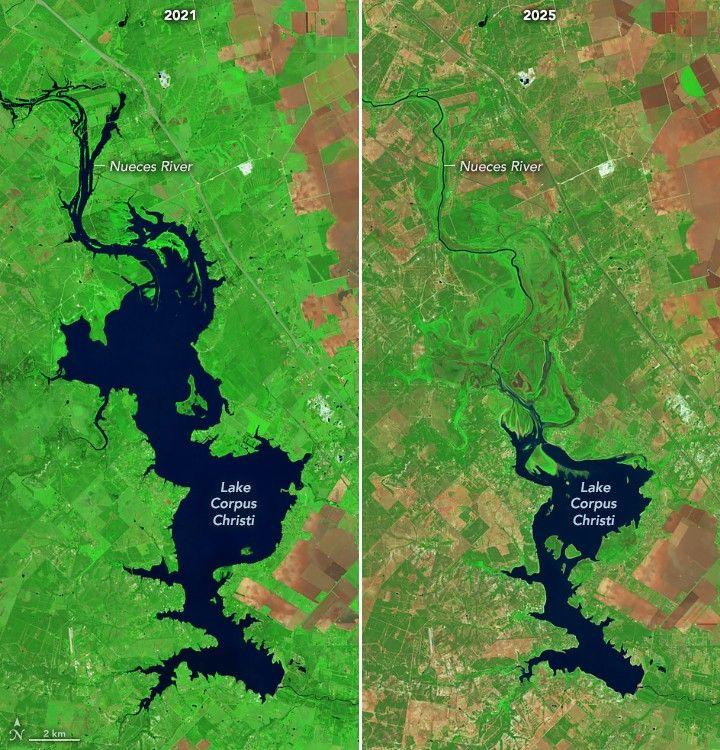
Regional drought concerns are raising new questions about water supply, growth and long-term planning across South Texas
By Kingsville Independent News Staff
What began as a drought concern centered on Corpus Christi is increasingly becoming a broader regional issue affecting communities across the Coastal Bend and South Texas.
In recent months, declining reservoir levels, emergency planning discussions and growing concerns about future water supply have prompted questions not only for Corpus Christi residents, but also for surrounding communities tied to the region’s economy, infrastructure and long-term development.
Much of the recent statewide attention surrounding the issue has stemmed from extensive reporting by The Texas Tribune, which has closely tracked Corpus Christi’s worsening drought conditions, emergency planning efforts and ongoing search for additional water sources.
But the concerns are also reflected in official state and municipal planning documents that suggest the challenges facing the Coastal Bend may extend well beyond one city.
According to the City of Corpus Christi’s official water supply dashboard, the city could enter a Level 1 water emergency later this year under certain drought conditions. The dashboard tracks reservoir levels, groundwater production and projected emergency timelines tied to the region’s water supply.
The city’s primary reservoirs, Choke Canyon Reservoir and Lake Corpus Christi, have remained at critically low levels following years of drought and increasing regional demand.
Data from Water Data for Texas, a statewide water monitoring resource supported by Texas water agencies and partners, recently showed the Nueces River Basin reservoir system hovering near critically low levels. The situation has intensified concern across South Texas as summer approaches.
In March, The Texas Tribune reported Corpus Christi officials warned the city could face a water emergency within months without significant rainfall or additional water sources.
At a March news conference, Corpus Christi City Manager Peter Zanoni attempted to reassure residents while acknowledging the seriousness of the situation.
“We are not there yet,” Zanoni said. “We’re not running out of water. This is no time to panic.”
Even so, the city has accelerated emergency groundwater projects and conservation planning in an effort to extend existing supplies.
According to reporting by The Texas Tribune and regional outlets, Corpus Christi has pursued emergency well projects, additional groundwater pumping and contingency measures while city leaders continue debating future mandatory reductions in water use for residents, businesses and industrial users.
The growing concern has already begun influencing daily behavior in Corpus Christi.
Recent reporting highlighted increased demand for rain barrels and household conservation tools as residents responded to worsening drought conditions and discussions surrounding possible emergency restrictions. Businesses have also begun preparing for the possibility of tighter conservation measures.
According to reporting highlighted by the Houston Chronicle and Public Health Watch, some Corpus Christi restaurants have already discussed serving water only upon request, reducing dishwashing loads and transitioning to disposable service items in an effort to conserve water if conditions worsen.
“Something has got to be done,” Corpus Christi restaurant owner May Mendoza told Public Health Watch. “And it’s got to be done soon.”
The issue extends beyond Corpus Christi city limits.
The regional water system tied to Corpus Christi serves roughly 500,000 people across seven counties while also supporting the Port of Corpus Christi and one of the nation’s largest petrochemical corridors, according to reporting by The Texas Tribune.
Industrial demand has become one of the central points of debate surrounding the region’s water future.
Multiple reports, including coverage from The Texas Tribune and Texas Observer, indicate industrial facilities account for roughly 50% to 60% of Corpus Christi’s total water demand.
The debate has intensified as residents, environmental advocates and officials question whether rapid industrial expansion along the Coastal Bend has outpaced long-term water planning efforts.
“It’s been like a slow train coming and now it’s at the station,” former Corpus Christi City Council member Jim Klein told Public Health Watch. “There’s been a standard practice here in Corpus Christi to sell water to anybody who wants it, to kind of treat water as an unlimited resource, and we’re finding out now it’s not unlimited.”
As drought conditions deepen, nearby communities have also begun pursuing emergency measures.
In April, The Texas Tribune reported that cities including Alice and Beeville had begun drilling groundwater wells as part of efforts to avoid future shortages. Experts interviewed by the publication cautioned that long-term dependence on groundwater could place additional pressure on local aquifers.
Regional drought contingency planning is also becoming increasingly visible outside larger cities.
The Nueces Water Supply Corporation, which serves rural customers in parts of South Texas, currently maintains public drought contingency measures outlining potential restrictions and conservation responses tied to worsening drought conditions.
While Kingsville has not announced emergency measures tied directly to Corpus Christi’s system, the growing regional conversation surrounding water has raised broader questions about long-term sustainability across the Coastal Bend and Brush Country.
Many communities throughout South Texas remain economically and operationally connected to Corpus Christi through healthcare systems, refinery operations, transportation corridors, shipping activity, agriculture and regional employment networks.
Questions surrounding future growth and infrastructure planning have also become part of the debate.
Earlier this year, the Texas Water Development Board approved updated regional water plans projecting billions of dollars in future infrastructure needs across Texas as communities prepare for continued population growth, drought conditions and rising demand.
A recent Houston Chronicle analysis noted the state could require roughly $174 billion in water infrastructure investments over the next 50 years to meet projected demand.
At the same time, officials continue exploring long-term supply projects, including desalination.
Corpus Christi officials are considering proposals tied to privately operated desalination facilities after the city previously abandoned a publicly backed desalination project amid environmental concerns and rising costs, according to The Texas Tribune and Texas Observer.
The proposed desalination projects have become controversial within some Corpus Christi neighborhoods and environmental groups, particularly over concerns involving industrial growth and the environmental effects of brine discharge into coastal waters.
The issue has increasingly become part of a larger statewide conversation about drought preparedness, infrastructure investment and the future of water management in Texas.
For communities across South Texas, the conversation is no longer centered only on Corpus Christi.
Whether through conservation efforts, groundwater development, infrastructure expansion or desalination, decisions being made along the Coastal Bend today may ultimately shape how the broader region manages water for years to come.