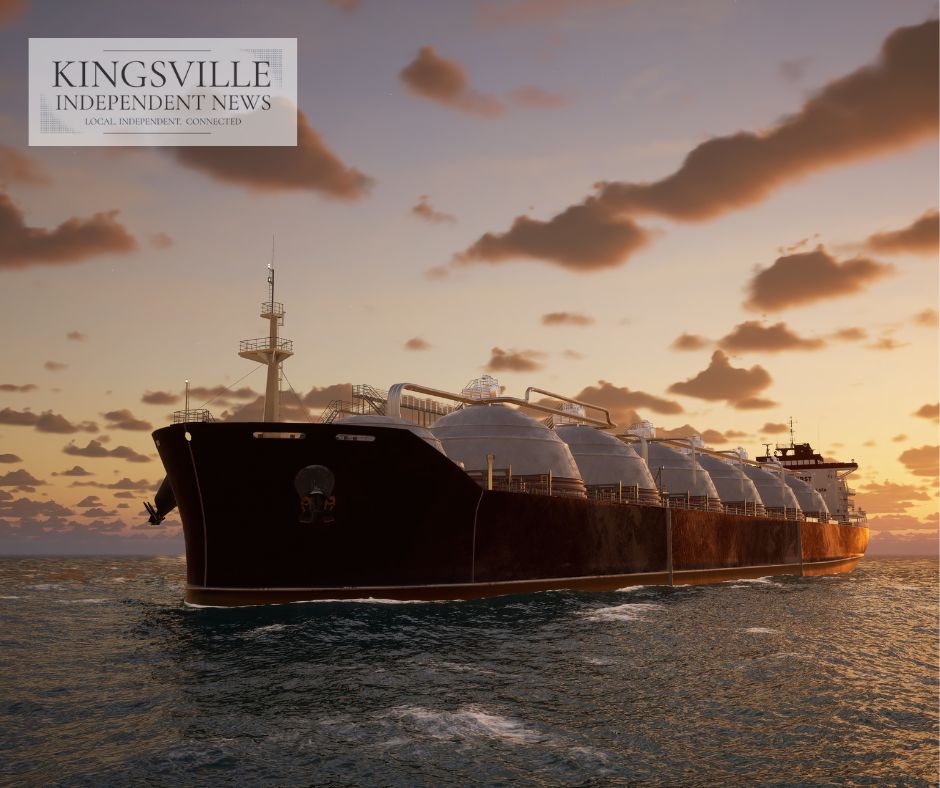
A three-part look at how Texas’ energy expansion reaches South Texas communities, from the Port of Corpus Christi to inland counties.
Editor’s Note: Last week, state and national leaders gathered at the Port of Corpus Christi to promote Texas’ growing role as a global energy exporter. References to “energy dominance” featured prominently in those remarks. This three-part series examines what that phrase means in practical terms for South Texas communities, from the coast to inland counties, and why it matters locally.
By Kingsville Independent News Staff
State and national leaders returned to the Port of Corpus Christi last week to spotlight what they described as Texas’ growing “energy dominance,” citing record oil and gas production, expanding liquefied natural gas (LNG) exports, and continued port development as signs of economic strength.
During the event, Gov. Greg Abbott and President Donald Trump pointed to infrastructure investments at the port, including channel deepening, as key drivers of job growth and private investment. Abbott said Texas is on track to become the world’s leading LNG exporter, while Trump framed energy production as both an economic engine and a national security priority.
The remarks raise a broader question for South Texas communities: What does “energy dominance” mean beyond the talking points, and why is Corpus Christi so central to it?
This article is the first in a three-part series exploring that question.
What leaders mean by “energy dominance”
In policy terms, energy dominance refers to a strategy focused on producing and exporting large volumes of oil, gas, and related products. The emphasis is not only on meeting domestic demand, but on supplying global markets, positioning the United States, and Texas in particular, as a leading energy exporter.
Texas plays a central role in that strategy. According to the U.S. Energy Information Administration, Texas produces more crude oil than any other state, accounting for roughly 40 percent of total U.S. production, along withnearly a third of the nation’s marketed natural gas output. That scale places Texas at the center of national export capacity.
Much of that production moves through coastal infrastructure. State economic data show the Port of Corpus Christi ranks among the largest energy export ports in the United States, handling a significant share of Texas’ crude oil shipments and serving as a major outlet for LNG and refined products moving to international markets. Recent channel deepening and terminal expansions have increased the port’s ability to load larger vessels and move higher volumes overseas.
Together, those factors underpin the energy dominance strategy, which relies on:
- High production levels
- Large-scale infrastructure
- Access to deepwater ports
- Regulatory and permitting frameworks designed to support rapid development
By linking inland production with global markets through ports like Corpus Christi, Texas has become the backbone of U.S. oil and gas exports.
Why the Port of Corpus Christi is at the center
The Port of Corpus Christi has become one of the nation’s most significant energy export hubs, moving crude oil, refined petroleum products, petrochemicals, and liquefied natural gas to overseas markets.
According to port and state economic data, Corpus Christi has ranked as the top U.S. crude oil export port in recent years, shipping well over 1.5 million barrels of crude oil per day at peak volumes. That scale places it ahead of many larger, more diversified ports when it comes specifically to energy exports.
The port’s role has expanded alongside major infrastructure investments. Federal and local funding has supported deepening the ship channel to roughly 54 feet, allowing fully loaded Very Large Crude Carriers (VLCCs) to dock directly at the port rather than relying on offshore transfers. For energy companies, that depth reduces shipping time and cost. For policymakers, it strengthens the port’s position in global energy trade.
That growth at the port is supported by an extensive inland pipeline network that delivers crude oil and natural gas from production areas across South Texas and beyond, linking inland counties directly to export activity on the coast.
State economic tracking shows the Port of Corpus Christi now accounts for roughly one-fifth of all Texas seaport trade by tonnage, despite handling a narrower range of cargo than ports such as Houston. Its activity is heavily concentrated in energy, a specialization that aligns closely with national export priorities.
In practical terms, energy dominance depends on ports capable of moving massive volumes of fuel quickly and efficiently. Corpus Christi is one of a small number of U.S. ports built and permitted to operate at that scale, making it a cornerstone of Texas’ energy export strategy.
How energy moves through South Texas
(A simplified look at the system behind “energy dominance”)
Energy exports leaving the Port of Corpus Christi do not begin at the water’s edge. They move through a connected system that stretches across South Texas and beyond.
Production
Oil and gas are produced in fields across Texas and neighboring states. In some cases, extraction also involves significant water use and waste byproducts that must be managed locally.
Processing and storage
Before export, energy products often pass through processing plants, storage tanks, and compression or liquefaction facilities. These sites may be located inland or near the coast, depending on infrastructure and land availability.
Pipelines and transport corridors
A network of pipelines, rail lines, and highways carries energy products toward the coast. Pipeline routes can cross rural land, ranches, and agricultural areas, creating long-term corridors that shape land use.
Water and disposal systems
Energy production and processing generate wastewater and brine that must be treated or disposed of, often through injection wells or specialized facilities. These systems rely on regulatory approvals and local geology.
Export through the port
At the Port of Corpus Christi, energy products are loaded onto large vessels bound for international markets. Channel depth, terminal capacity, and ship traffic determine how much energy can move, and how quickly.
Together, these pieces form the backbone of Texas’ energy export economy, linking inland communities to global markets, often in ways that are not immediately visible.
Why this matters locally
Even communities far from the coast can be part of this system, through water use, pipeline routes, land access, or regulatory decisions that support energy movement toward the port.
Jobs, growth, and what often goes unsaid
Supporters of energy expansion frequently point to job creation, corporate investment, and tax revenue as major benefits. Construction of terminals, pipelines, and related infrastructure can generate short-term employment and economic activity across the region.
Longer-term impacts are more complex. Operational phases typically require fewer workers, and many specialized positions are filled by an out-of-area workforce. How economic gains translate into sustained local benefits, such as services, infrastructure, or long-term employment, can vary widely by community.
Those distinctions are often absent from high-level announcements but play a significant role in how growth is experienced locally.
Why this matters beyond the coast
Although the Port of Corpus Christi sits on the Gulf Coast, the system that feeds it stretches far inland. Energy dominance does not begin at the shoreline. It depends on pipelines, processing facilities, water supplies, land access, and disposal systems that extend across South Texas.
For inland communities, those connections can influence land use, water planning, and regulatory decisions, even when the final export point is miles away. What appears locally as a pipeline proposal, a water-use permit, or a disposal application is often part of a much larger export network tied to coastal infrastructure.
In that way, inland counties may experience the effects of energy expansion through planning and permitting decisions rather than visible export activity, underscoring how global markets can shape local choices without ever passing through town.
What comes next
This first installment sets the stage for understanding energy dominance as a system rather than a slogan. The next article will examine how port-driven energy expansion reaches inland counties, including the infrastructure and resources required to support large-scale exports.
The final piece will look at who benefits, who bears the costs, and what questions communities continue to weigh as South Texas plays an expanding role in global energy markets.