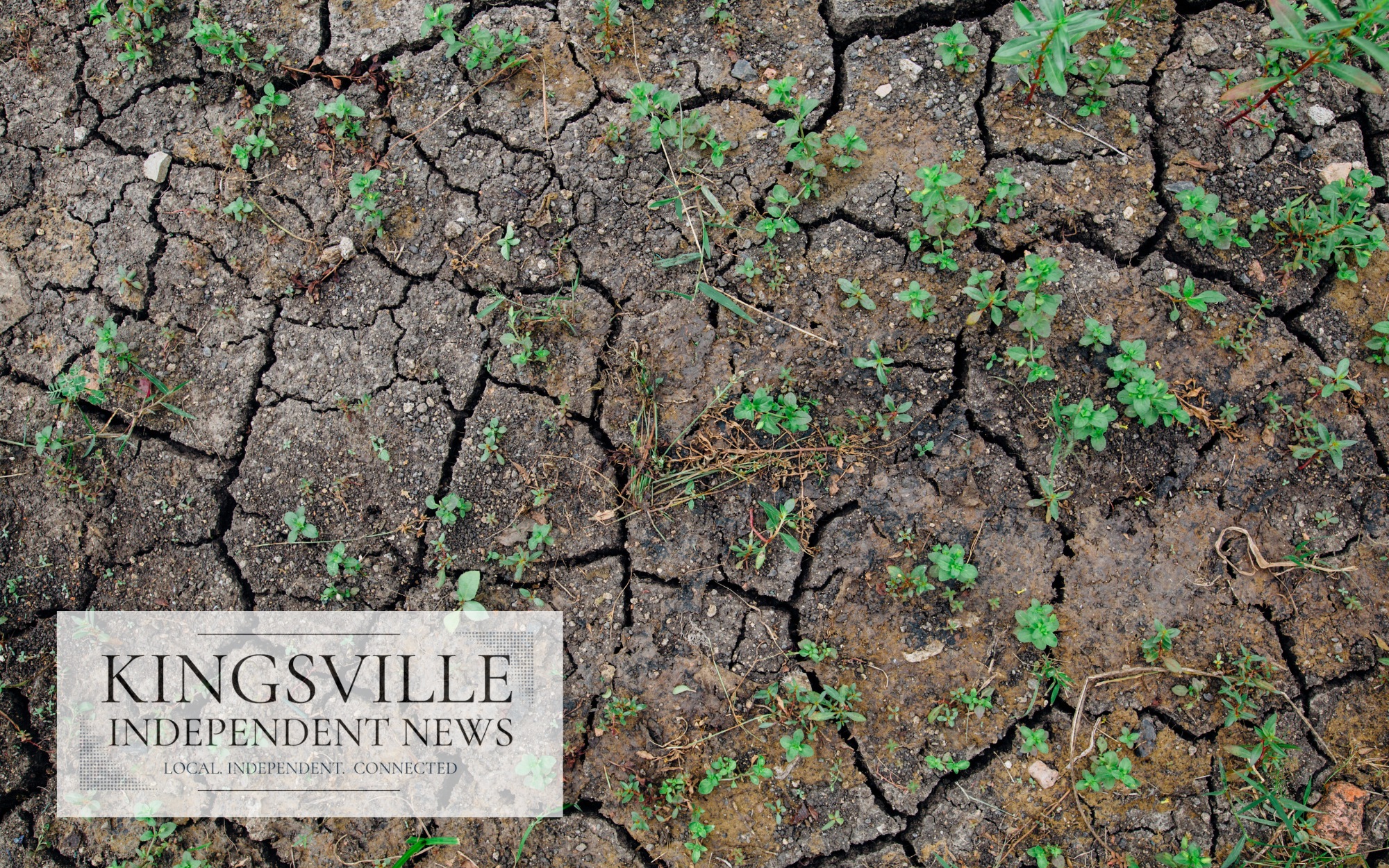
Critically low reservoir levels in South Texas continue to signal concern for Coastal Bend communities that rely on shared water supplies
By Kingsville Independent News Staff
Corpus Christi has remained under Stage 3 drought restrictions since December 2024, after City Manager Peter Zanoni formally declared Stage 3 under the city’s Drought Contingency Plan, which authorizes the city manager to act when combined lake levels fall below 20% capacity.
At the time of the declaration on Dec. 11, 2024, combined levels in Lake Corpus Christi and Choke Canyon Reservoir measured 19.9%, according to the city’s official announcement.
As of Dec. 4, 2025, combined reservoir storage has declined further to 10.8%, based on data published by Corpus Christi Water.
These restrictions apply to residential, commercial, institutional and industrial water users within Corpus Christi, including homeowners, apartment complexes, schools, churches, city properties, businesses and industry.
While the restrictions began last year, continued reservoir decline, limited rainfall and prolonged drought conditions have renewed regional concern, prompting Kingsville Independent News to revisit the issue.
Stage 3 has now remained in effect for nearly a year, with no formal city announcement lifting or modifying the restriction level in recent months. With storage continuing to drop and no meaningful recovery projected, the drought’s duration raises questions for Kingsville, Kleberg County and other communities connected to the same regional water system.
Timeline: How Stage 3 drought restrictions began
Dec. 11, 2024 — Reservoir threshold crossed
Combined storage levels in Lake Corpus Christi and Choke Canyon Reservoir fell below 20% capacity, triggering the city’s drought contingency threshold.
Dec. 16, 2024 — Stage 3 declared
City Manager Peter Zanoni formally declared Stage 3 drought restrictions, placing mandatory conservation measures into effect across Corpus Christi.
December 2024–March 2025 — Restrictions remain in effect
Ongoing drought conditions, limited rainfall and sustained demand kept reservoir levels critically low, according to Corpus Christi Water and Water Data for Texas.
March 20, 2025 — Stage 3 reaffirmed
The city issued a public notice confirming Stage 3 remained in effect until further notice.
Dec. 4, 2025 — Storage drops to 10.8%
Corpus Christi Water’s public drought dashboard reported combined reservoir storage at 10.8%, reflecting continued decline with no significant recovery.
Why this matters now for Kingsville
Although Stage 3 began last year, drought conditions have persisted with worsening reservoir conditions. Storage tracked by the Texas Water Development Board continues to trend far below seasonal norms, and the region remains in an extended dry cycle with limited inflows.
Kingsville and nearby communities receive water through the South Texas Water Authority, which purchases treated water from Corpus Christi Water. Prolonged drought in the region’s primary surface-water reservoirs serves as an early indicator that surrounding cities may eventually be asked to adopt similar conservation measures.
What Stage 3 means in Corpus Christi
Under the city’s drought contingency plan, Stage 3 restrictions include:
- No landscape irrigation using automatic sprinklers or drip systems
- No at-home vehicle washing with hoses
- Outdoor fountains must operate only with recirculated water
- Potted plants and gardens may be watered by hand only before 10 a.m. or after 6 p.m.
- Foundation watering allowed only by bucket, hose with shutoff nozzle or drip system
Indoor household water use is not restricted.
Violations may result in fines of up to $500 per day, according to Corpus Christi Water.
Potential impacts on Kingsville and the Coastal Bend
Shared water supply
Kingsville receives water through the South Texas Water Authority, which relies on treated surface water supplied by Corpus Christi. Prolonged drought may eventually result in:
- Adjusted local watering schedules
- Voluntary or mandatory conservation measures
- Limits on nonessential outdoor water use
Agricultural and business impacts
Local ranches, farms, nurseries and landscaping businesses could face increasing strain if additional conservation stages are triggered. High-use industries may be required to modify water-use practices or reduce consumption.
Long-term water planning
The drought underscores South Texas’ heavy reliance on rainfall-fed surface water systems. State and regional agencies, including the Texas Water Development Board, continue exploring long-term strategies such as groundwater development, water reuse, expanded pipelines and other drought-resilient supply options.
What Kingsville residents can do now
While Kingsville is not currently under mandatory drought restrictions, residents are encouraged to conserve water by:
- Reducing outdoor watering
- Repairing household leaks promptly
- Limiting car washing
- Avoiding unnecessary water use
- Monitoring updates from the City of Kingsville, South Texas Water Authority and Corpus Christi Water
What comes next
If drought conditions continue to worsen, Corpus Christi could eventually move into Stage 4, the highest restriction level under its drought contingency plan. Such a move would have broader implications for communities supplied by the regional system.
For now, Stage 3 remains in effect with no projected end date, and reservoir levels continue to decline. Kingsville Independent News will continue monitoring updates from regional and state water authorities as drought conditions evolve.
This report was compiled using public data from regional and state water authorities.
Sources
- City of Corpus Christi — Drought Contingency Plan and public notices
- Corpus Christi Water — Stage 3 drought dashboard and reservoir data (Dec. 4, 2025)
- South Texas Water Authority — Regional water supply information
- Texas Water Development Board — Reservoir storage data
- U.S. Drought Monitor — Regional drought classifications
- NASA Earth Observatory — Climate and satellite data


